
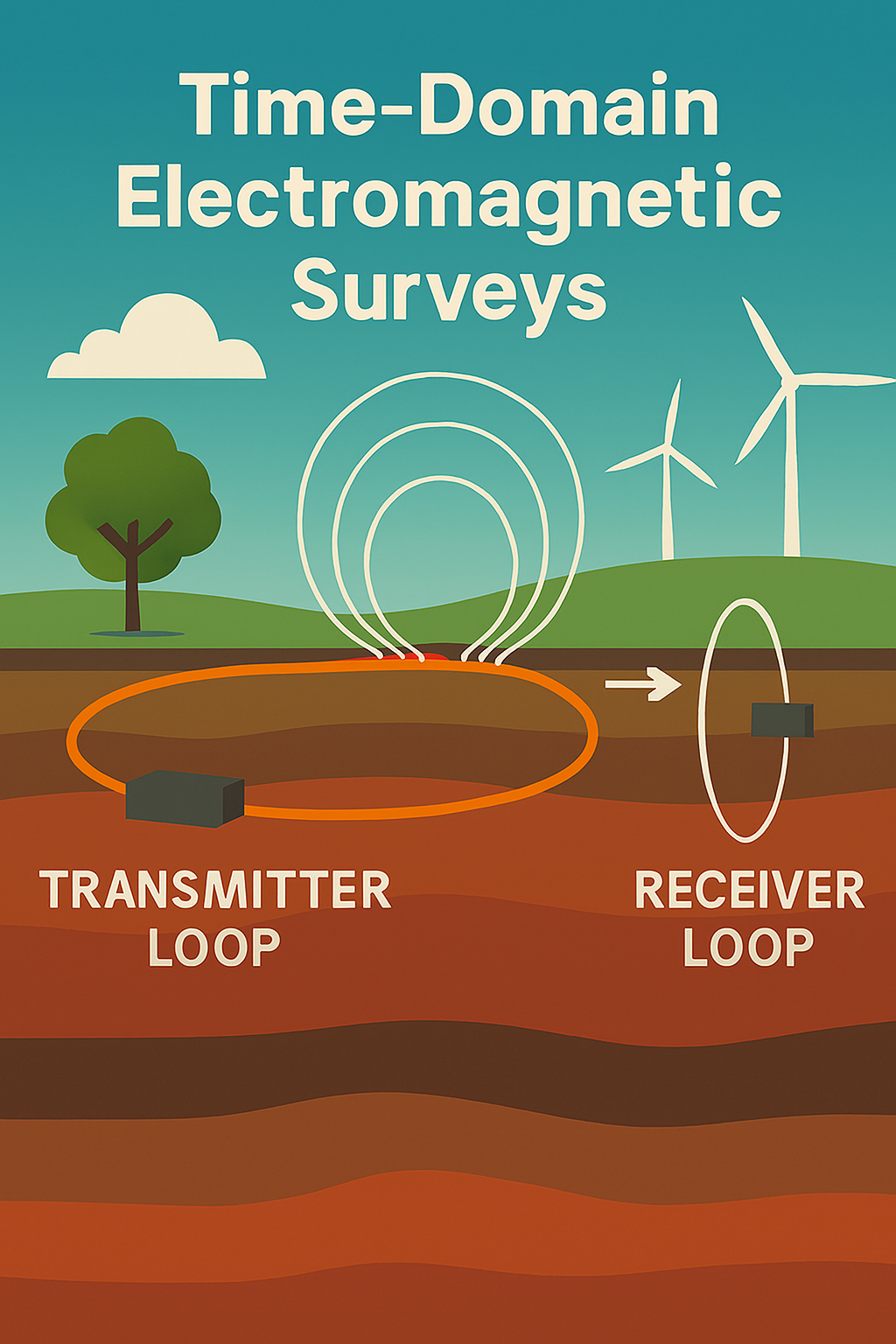

Time-Domain Electromagnetic (TDEM), also known as Transient Electromagnetic (TEM), is a non-invasive geophysical technique that measures how the Earth responds to a pulsed electromagnetic field. The method involves:
- Generating a magnetic field using a transmitter loop energized with direct current.
- Shutting off the current abruptly, which induces eddy currents in the subsurface.
- Measuring the decay of these currents over time using a receiver coil or loop.
The rate and pattern of decay reveal the electrical resistivity of underground materials, helping geoscientists build a layered model of the subsurface.
🌍 Applications of TDEM Surveys
TDEM surveys are widely used across industries due to their depth penetration and versatility:
- Mineral exploration: Detects conductive ore bodies like sulfides and graphite.
- Groundwater mapping: Identifies aquifers and water-bearing formations.
- Environmental assessment: Locates buried waste, contamination plumes, and landfill boundaries.
- Geotechnical investigations: Assesses subsurface conditions for infrastructure development.
- Unexploded ordnance (UXO) detection: Sensitive to metallic objects buried underground.
🛠️ How TDEM Works in Practice
A typical TDEM setup includes:
- Transmitter loop: A large wire loop laid on the ground, energized with 10–30 A of current.
- Receiver coil: Placed at the center or offset from the transmitter to record the secondary magnetic field.
- Data acquisition system: Captures voltage decay over time, which is then processed to model resistivity.
The depth of investigation depends on the size of the loop, current strength, and resistivity of the ground. TDEM can probe depths from tens to hundreds of meters.
✅ Advantages of TDEM Surveys
- Non-invasive: No need for drilling or direct ground contact.
- High resolution: Sensitive to subtle changes in resistivity.
- Depth penetration: Effective in detecting deep targets.
- Adaptable: Works well in resistive terrains where other methods fail.
- Cost-effective: Covers large areas quickly with minimal environmental impact.
⚠️ Limitations and Considerations
- Noise sensitivity: Urban environments can interfere with signal quality.
- Complex interpretation: Requires skilled geophysicists to model and validate results.
- Limited lateral resolution: Best suited for layered or vertically varying geology.
Despite these challenges, TDEM remains a cornerstone of subsurface exploration, especially when combined with other geophysical methods.
Sources: US EPA – TDEM Overview Wikipedia – Transient Electromagnetics Tellus-Explora – TDEM Methods