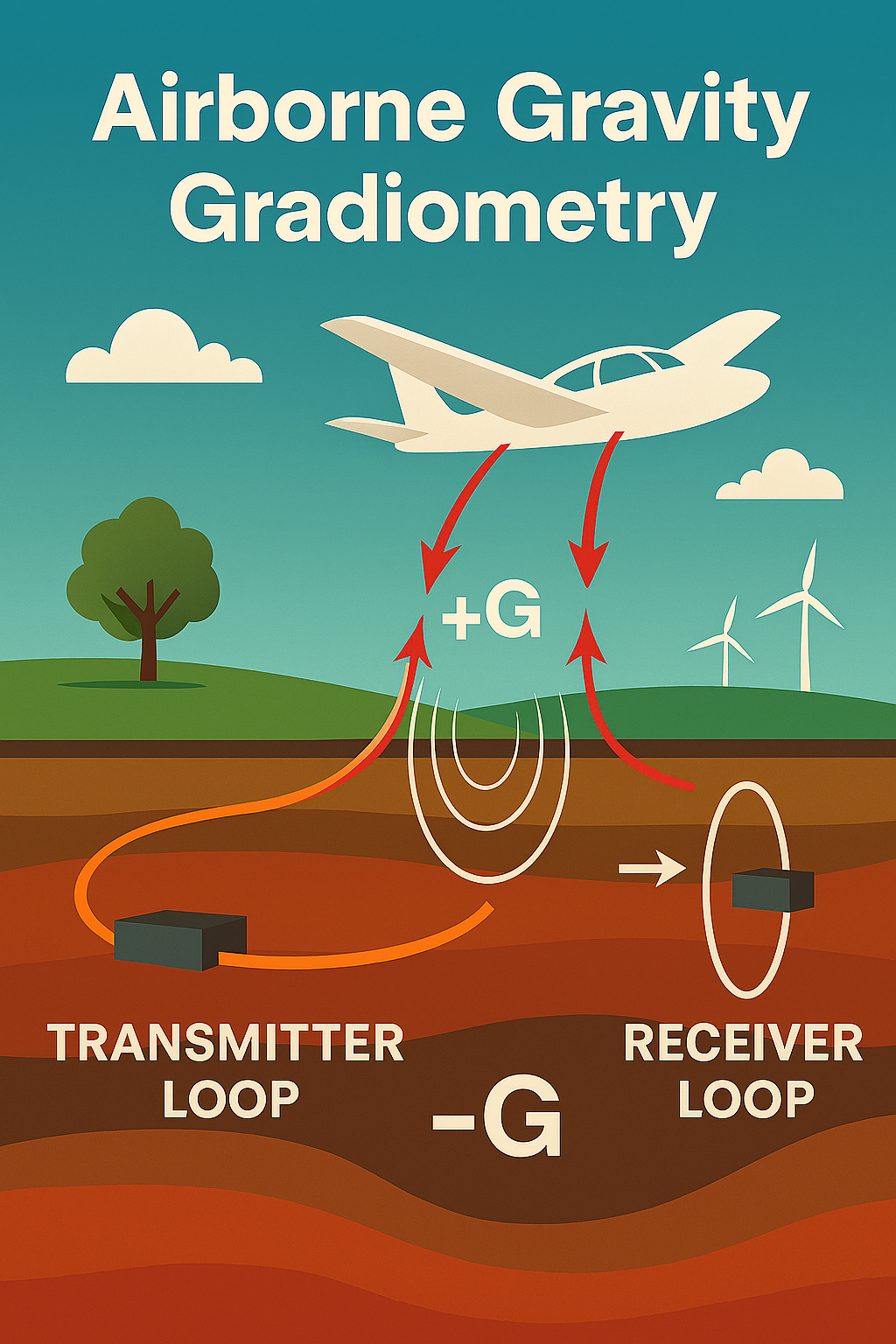

Airborne Gravity Gradiometry (AGG) is a cutting-edge geophysical technique that measures subtle variations in the Earth's gravitational field from the air. By detecting changes in gravity gradients, AGG reveals the density distribution of subsurface rocks—making it an invaluable tool for mineral exploration, geological mapping, and environmental assessment.
🧲 What Is Gravity Gradiometry?
Unlike traditional gravity surveys that measure the absolute gravitational pull, gravity gradiometry focuses on the rate of change of gravity over short distances. These gradients are more sensitive to small, near-surface features and allow for high-resolution imaging of geological structures.
AGG systems are mounted on aircraft and use ultra-sensitive accelerometers to detect minute differences in gravitational acceleration between multiple points. These differences are processed into gradient maps that highlight subsurface anomalies.
🌍 Applications of Airborne Gravity Gradiometry
AGG is widely used across industries due to its depth penetration, resolution, and efficiency:
- Mineral exploration: Detects dense ore bodies like iron, copper, and nickel.
- Oil and gas: Maps sedimentary basins and fault structures.
- Geological mapping: Defines lithological boundaries and structural features.
- Environmental studies: Identifies buried waste, sinkholes, and subsurface cavities.
- Infrastructure planning: Assesses subsurface stability for tunnels, dams, and roads.
Its ability to cover vast areas quickly makes AGG ideal for remote or inaccessible regions.
🛠️ How It Works
AGG systems typically include:
- Gradiometer sensors: Measure gravity gradients along multiple axes.
- Inertial navigation systems: Track aircraft motion and correct for noise.
- GPS units: Provide precise location data for mapping.
The aircraft flies in a grid pattern at low altitude, and the system records gravity gradient data continuously. Advanced processing removes noise from aircraft motion and environmental factors, yielding high-resolution subsurface maps.
✅ Advantages of AGG
- High resolution: Detects small-scale features missed by conventional gravity surveys.
- Non-invasive: No ground contact required.
- Efficient: Covers large areas in a short time.
- Cost-effective: Reduces the need for extensive ground crews.
- Complementary: Enhances other geophysical methods like magnetics and radiometrics.
⚠️ Limitations
- Complex data processing: Requires sophisticated algorithms and expertise.
- Sensitivity to aircraft motion: Demands precise stabilization and calibration.
- Limited depth resolution: Best suited for near-surface to mid-depth targets.
Despite these challenges, AGG remains one of the most powerful tools for subsurface exploration, especially when integrated with other airborne geophysical techniques.
Sources: CGG – Gravity Gradiometry Overview Geosoft – Airborne Gravity Gradiometry Wikipedia – Gravity Gradiometry