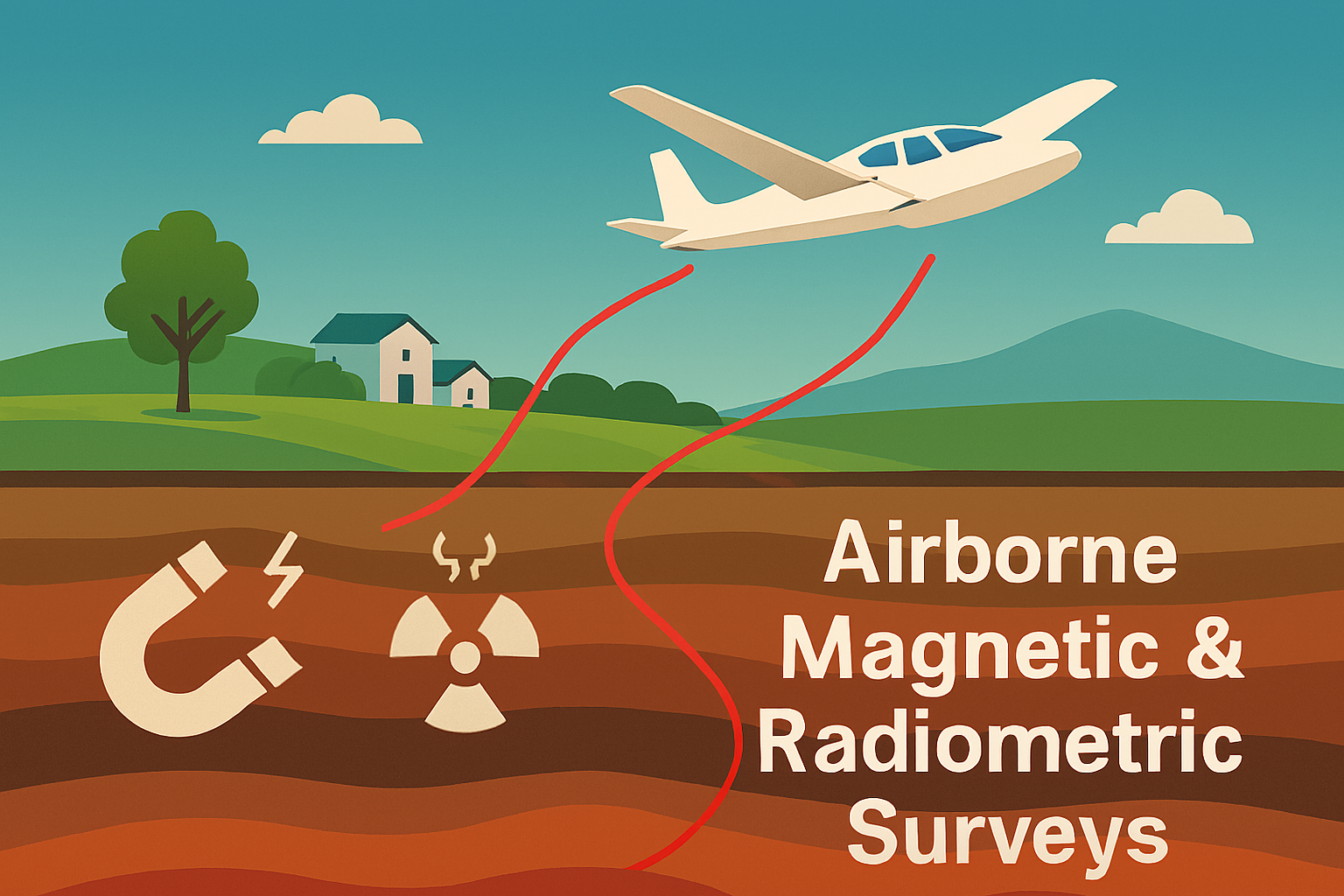

Airborne magnetic and radiometric surveys are geophysical techniques that involve flying aircraft equipped with sensitive instruments over large areas to measure variations in the Earth's magnetic field and natural gamma radiation. These variations help geoscientists infer the composition, structure, and mineral content of the subsurface without drilling or excavation.
- Magnetic surveys detect anomalies caused by magnetic minerals like magnetite and pyrrhotite, revealing faults, folds, and buried rock formations.
- Radiometric surveys measure gamma rays emitted by radioactive elements such as uranium, thorium, and potassium, which are naturally present in rocks and soils.
Together, these methods provide a powerful, non-invasive way to "see" beneath the Earth's surface.
🌍 Applications in Sustainable Development
Airborne magnetic and radiometric surveys play a vital role in sustainable development by supporting:
- Mineral exploration: Identifying deposits of critical minerals (e.g., rare earths, lithium, copper) needed for renewable energy technologies.
- Environmental monitoring: Mapping soil types, contamination zones, and geological hazards to guide land use and conservation.
- Water resource management: Locating aquifers and understanding subsurface geology to improve groundwater access.
- Infrastructure planning: Informing the placement of roads, pipelines, and buildings by revealing subsurface risks.
These surveys help reduce the environmental footprint of exploration by narrowing down target zones before any ground disturbance occurs.
🛠️ How the Technology Works
Aircraft—often fixed-wing planes or helicopters—fly in systematic grid patterns at low altitudes. Instruments onboard include:
- Magnetometers: Measure the intensity and direction of the magnetic field.
- Gamma spectrometers: Detect and quantify gamma radiation from the ground.
Data is collected continuously and processed to produce high-resolution maps that visualize subsurface features. These maps are then interpreted by geophysicists and geologists to guide further exploration or planning.
⚡ Advantages Over Ground-Based Methods
- Speed: Large areas can be surveyed in days rather than months.
- Accessibility: Remote or rugged terrain can be covered without physical access.
- Cost-effectiveness: Reduces the need for extensive ground crews and equipment.
- Data richness: Provides multi-layered insights that integrate with other geoscientific data.
🔍 Real-World Impact
In regions with limited surface exposure—such as areas covered by vegetation, soil, or urban development—airborne surveys are often the only viable method for geological investigation. For example, Australia's MinEx CRC initiative uses airborne magnetic and radiometric data to uncover hidden mineral systems beneath cover rocks.
Sources: Xcalibur Smart Mapping – Airborne Magnetics and Radiometrics Geology Science – Magnetic Surveys Overview NSW Resources – AMR Survey Factsheet