
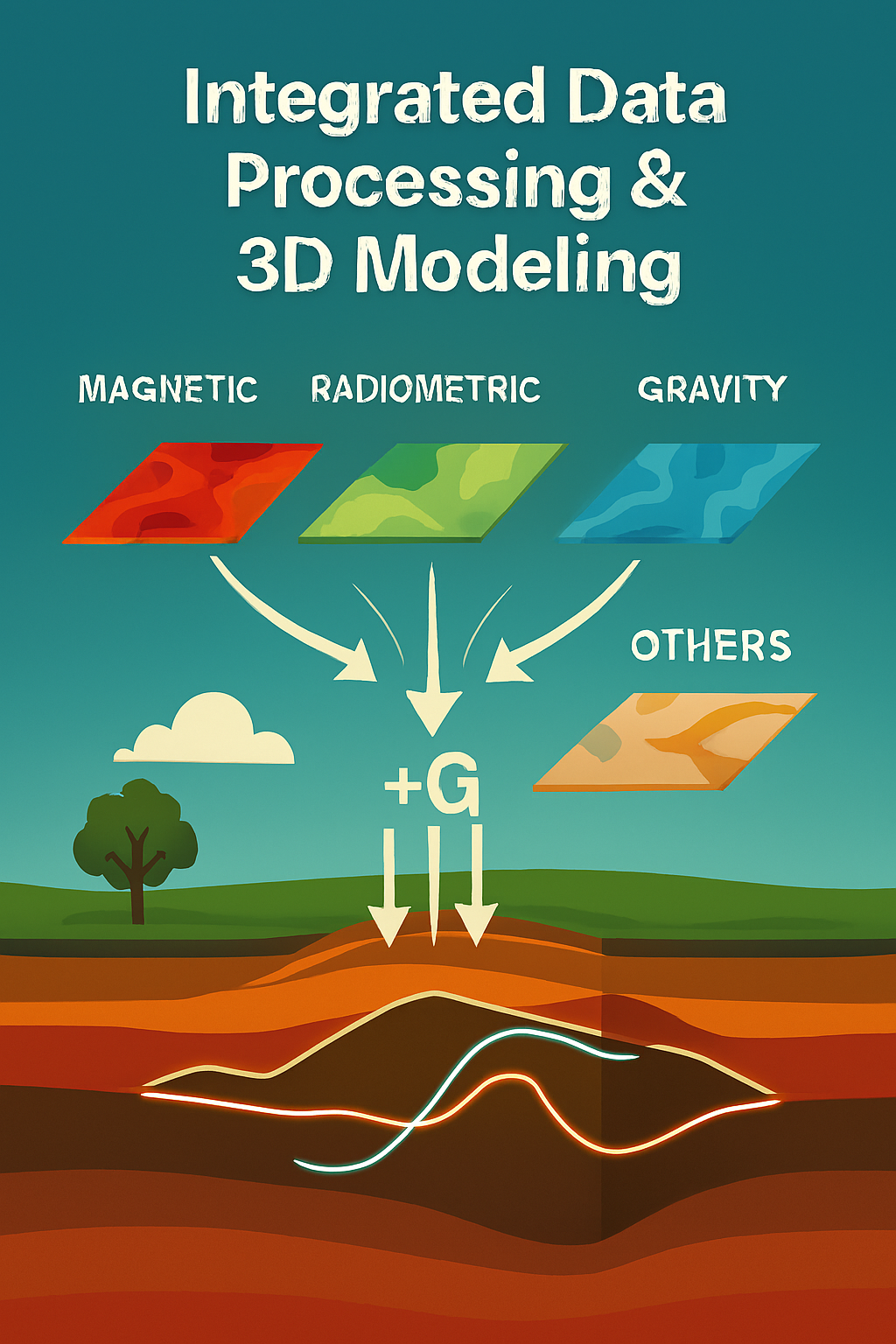

Integrated data processing refers to the systematic combination of multiple geoscientific datasets—such as magnetic, radiometric, gravity, seismic, and geological data—into a cohesive framework. Rather than analyzing each dataset in isolation, integration allows geoscientists to:
- Correlate anomalies across datasets
- Reduce uncertainty in interpretation
- Enhance spatial resolution and geological accuracy
This approach is especially powerful in complex terrains where single-method surveys may miss critical subsurface features.
🧱 What Is 3D Geological Modeling?
3D modeling transforms raw geophysical and geological data into interactive, volumetric representations of the Earth’s subsurface. These models visualize:
- Lithological boundaries
- Faults and folds
- Ore bodies and aquifers
- Depth-to-basement and structural layers
Modern modeling platforms use algorithms like kriging, implicit modeling, and machine learning to interpolate between data points and generate realistic geological volumes.
🔗 Why Integration Matters
When data from airborne surveys, boreholes, and field mapping are processed together, the resulting 3D models become more robust and predictive. Benefits include:
- Improved targeting for mineral and hydrocarbon exploration
- Enhanced groundwater modeling for sustainable resource management
- Accurate risk assessment for infrastructure and environmental planning
- Better communication of subsurface complexity to stakeholders
Integrated workflows also support iterative updates as new data becomes available, making models dynamic and adaptive.
🛠️ Tools & Techniques
Key technologies and methods used in integrated 3D modeling include:
- GIS platforms (e.g., ArcGIS, QGIS) for spatial data management
- Geophysical inversion software (e.g., Geosoft Oasis montaj, Leapfrog Geo)
- Machine learning frameworks for pattern recognition and classification
- Cloud-based collaboration for multi-disciplinary teams
These tools enable geoscientists to work across disciplines, from exploration geology to environmental engineering.
🌍 Real-World Impact
Integrated 3D models are being used to:
- Map mineral systems in covered terrains (e.g., Australia’s MinEx CRC)
- Predict groundwater flow in fractured aquifers
- Assess geohazards in urban development zones
- Guide carbon capture and storage (CCS) site selection
As data acquisition becomes more automated and AI-driven, integrated modeling will become the backbone of digital geoscience.
Sources:
- Springer – Integrated Framework for Geological Modeling
- MDPI – 3D Geological Modeling Review
- ResearchGate – Machine Learning for 3D Modeling